


Understanding the Rules of the Pusoy Card Game
Ever found yourself at a family gathering when someone pulls out a deck of cards and says, “Let’s play Pusoy!”? If you’ve ever had to just nod along, hoping to pick up the rules as you go, you’re in the right place. This guide is designed to have you confidently saying “Deal me in” before the first hand is even over. To know more, check out uniworldcongress.org
Unlike the high-stakes bluffing seen in games like Texas Hold’em, Pusoy is a game of clever arrangement. Think of it less as a betting showdown and more as a fascinating puzzle you solve with the 13 cards you’re dealt. As one of the most popular Filipino card games for groups, its real magic lies in outsmarting opponents by simply placing your cards in the smartest possible order.
Learning the pusoy card game rules is surprisingly straightforward because the entire game balances on a single, foundational principle. Mastering this one “Golden Rule” of setting your hands is the key that unlocks everything else. Once you understand it, every other step clicks into place, transforming a confusing mess of cards into a clear strategic choice.
This guide on how to play pusoy for beginners will get you into the action immediately. You won’t just learn the theory; you’ll gain the confidence to arrange your cards, compare hands with friends, and enjoy your very first game from start to finish.
The #1 Thing You MUST Know: Pusoy Hand Rankings from Strongest to Weakest
Before you can place a single card, you need to understand what makes a good hand. Everything in Pusoy, from arranging your cards to scoring, depends on knowing the official ranking of hands. Think of this as your “cheat sheet” for what beats what. The hand at the top of the list is the strongest, and they get progressively weaker as you go down. Don’t worry about memorizing it all at once; just keep this list handy during your first few games.
Here is the complete Pusoy hand rankings chart, from the unbeatable Royal Flush down to a simple High Card.
- Royal Flush: The best possible hand. It’s the Ace, King, Queen, Jack, and 10, all of the same suit.
- Example: A♠ K♠ Q♠ J♠ 10♠
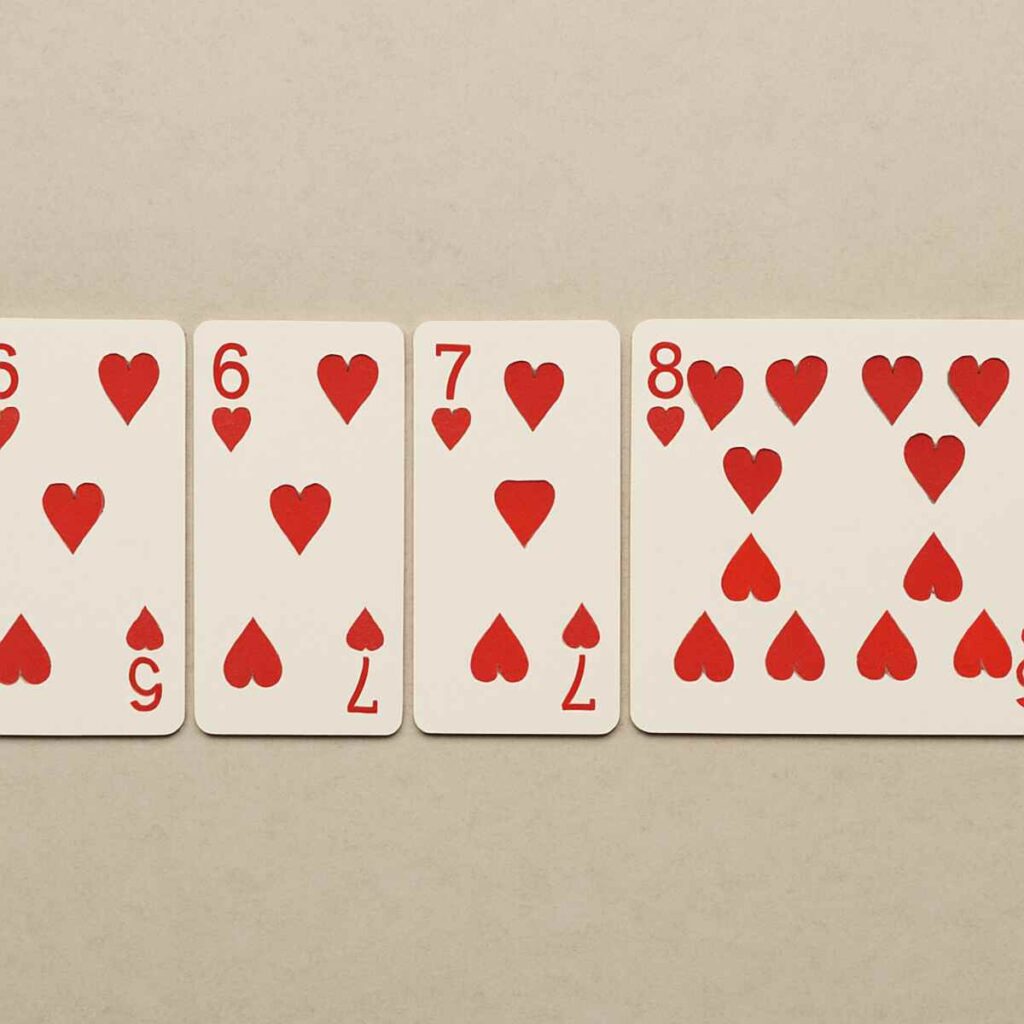
- Straight Flush: Five cards in a sequence (like 5, 6, 7, 8, 9), all of the same suit.
- Example: 9♥ 8♥ 7♥ 6♥ 5♥
- Four of a Kind: Four cards of the same rank (e.g., four Jacks).
- Example: J♣ J♦ J♥ J♠ 4♦
- Full House: A combination of Three of a Kind and a Pair.
- Example: 7♣ 7♠ 7♦ K♥ K♠
- Flush: Any five cards of the same suit, but not in a sequence.
- Example: A♥ K♥ 10♥ 5♥ 2♥
- Straight: Five cards in a sequence, but from different suits.
- Example: 8♥ 7♠ 6♦ 5♣ 4♥
- Three of a Kind: Three cards of the same rank.
- Example: 5♠ 5♣ 5♥ A♦ 9♣
- Two Pair: Two different pairs in one hand.
- Example: K♥ K♠ 4♣ 4♦ 10♠
- One Pair: The simplest hand. Just two cards of the same rank.
- Example: A♣ A♥ 9♠ 7♦ 3♣
- High Card: If you have none of the above, your hand is judged by its single highest-ranking card.
- Example: A♥ Q♦ 10♣ 5♠ 2♦ (This would be called “Ace-High”)
Now that you know what makes a strong hand, the next step is learning how to use them. The entire game of Pusoy revolves around arranging your 13 cards into three separate hands according to one simple but crucial rule.
The Golden Rule of Pusoy: How to Arrange Your 13 Cards Correctly
Now that you can tell a Full House from a Flush, it’s time to put that knowledge to work. In Pusoy, your main job is to arrange your 13 dealt cards into three distinct hands: a 5-card Back Hand, a 5-card Middle Hand, and a 3-card Front Hand. Since the Front hand only has three cards, the strongest it can be is Three of a Kind.
This leads us to the single most important rule in the entire game, often called the Golden Rule. Your Back hand must be stronger than (or equal to) your Middle hand, and your Middle hand must be stronger than your Front hand. Think of it like building a pyramid: the strongest, most stable foundation goes at the bottom (Back), the next strongest goes in the middle, and the weakest hand sits at the top (Front).
Getting this order wrong is called a foul or a mis-set hand, and it’s one of the most common Pusoy mistakes to avoid. The penalty is severe: if you declare a foul hand, you automatically lose against every other player, regardless of how good your individual cards are. A Royal Flush in the Front won’t do you any good if you only have a pair in the Back!
Therefore, the real challenge of Pusoy isn’t just getting lucky with your deal—it’s the puzzle of finding the best valid Pusoy hand combinations. You constantly have to decide whether to go for one monster hand or spread your strength across all three. To see how this works in practice, let’s walk through setting a real hand.
A Step-by-Step Example: Setting a Real Pusoy Hand
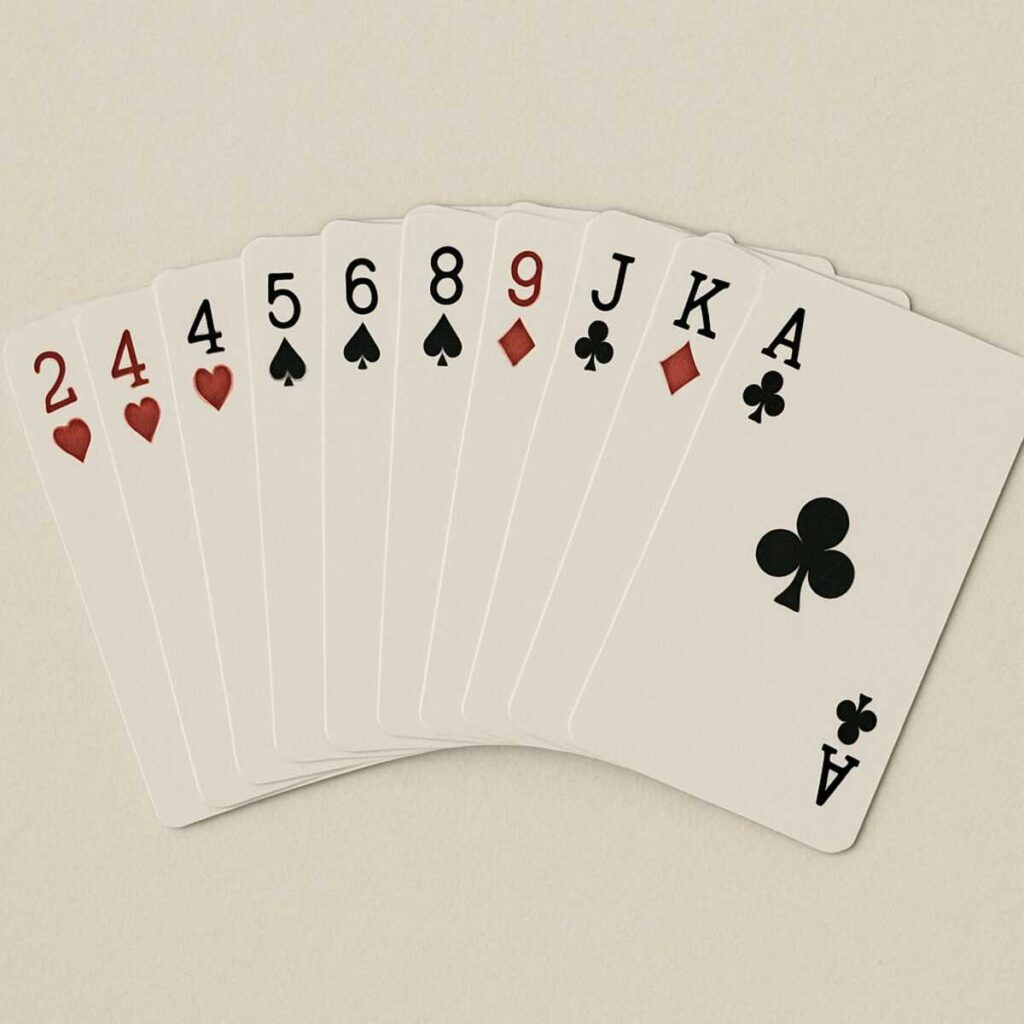
Imagine you’ve been dealt the following 13 cards: K♠, Q♠, 8♠, 5♠, 2♠, K♥, K♦, 7♣, 7♦, J♥, 10♣, 4♦, A♣.
At first glance, it might look like a jumble, but a quick scan reveals some powerful potential. Your first instinct should be to look for the easy wins: straights, flushes, or multiple pairs. In this hand, two things jump out immediately: you have five Spades (a Flush) and two separate pairs (a pair of Kings and a pair of Sevens). This is a great starting point and gives you clear options for building your three hands. This initial scan is a crucial first step in any pusoy strategy for beginners.
With a strong Flush in hand, the safest and smartest move is to place it in your Back hand. Since the Back must be your strongest hand, locking in a powerful combination like a Flush (K♠ Q♠ 8♠ 5♠ 2♠) provides a solid foundation and dramatically reduces your risk of fouling. You now only have eight cards left to worry about, making the puzzle much simpler.
With the Back hand locked in, the remaining cards (K♥, K♦, 7♣, 7♦, J♥, 10♣, 4♦, A♣) must form the Middle and Front hands. The best 5-card hand you can make here is Two Pair, using your Kings and Sevens. We’ll use the Ace as the fifth card, or “kicker,” giving us K♥ K♦ 7♣ 7♦ A♣. Now, double-check: is our Back hand (Flush) stronger than our Middle hand (Two Pair)? Yes. We’re on the right track.
All that’s left are three cards for the Front: J♥, 10♣, and 4♦. This gives you a simple “High Card” hand (specifically, Jack-high). The final and most important check is to ensure your Middle hand (Two Pair) is stronger than your Front hand (Jack-high). It is, which means you have successfully set a valid hand. You’ve mastered how to arrange 13 cards in Pusoy.
This process—scan, place your strongest hand in the back, then build forward while constantly checking against the Golden Rule—is the core of setting your hand every round. Now that your cards are arranged, it’s time for the fun part: seeing how they stack up against everyone else’s.
The Showdown: How to Compare Hands and Win a Round
Once every player has arranged their 13 cards, the moment of truth arrives. This is the showdown, where everyone reveals their hands simultaneously. Unlike poker games where players bet and fold in sequence, in Pusoy everyone lays their three hands face-up on the table, organized with the Back hand at the bottom, Middle in the middle, and Front on top. The strategic arrangement you just did is about to pay off.
Instead of one big, confusing comparison, you’ll resolve the round in three distinct, head-to-head battles against each other player. First, everyone compares their Front hand only against everyone else’s Front hand. Then, you do the same for the Middle hands, and finally, for the Back hands. You are essentially playing three mini-games against each opponent at the table, one for each hand position.
So, how do you score in pusoy? The most common way to play uses a simple point system. For each head-to-head comparison you win, you earn one point from that specific player. For example, if your Front hand (a pair of 6s) beats Player A’s Front hand (King-high), you get one point from Player A. It’s possible to win the Front comparison but lose the Middle one to the same person.
Winning one or two of these mini-games against an opponent is a typical outcome. However, there’s a special, game-changing bonus for when you manage to dominate a player completely by winning all three comparisons against them. This powerful move is what separates a good round from a great one, and it’s called “scooping.”
The Ultimate Win: How to “Scoop” Your Opponents
Winning all three matchups against a single opponent is called a scoop, or sometimes a sundang. Think of it as a clean sweep. While winning your Front hand and losing your Back hand to the same player results in a net exchange of zero points, a scoop is a total victory that dramatically shifts the score. It’s a powerful play that everyone at the table watches out for, turning a good round into a dominant one.
So what makes a scoop so special? The bonus points. When you scoop an opponent, you don’t just get the three points from winning each hand individually. Most rules award you a bonus, doubling your winnings to a total of six points from that player. This rule is a critical part of any Chinese poker rules guide because it creates huge swings. Scoring in Pusoy comes down to this: win individual hands for small gains, but achieve scoops for big ones.
Because of this massive point swing, engineering a potential scoop is a core pusoy strategy to win. It often involves sacrificing a little strength in one hand to ensure you can beat an opponent’s cards across the board. While a scoop is the ultimate result you can construct, some rare hands are so powerful they win bonus points all on their own, even before the comparisons begin. These special hands are called “naturals.”
Beyond the Basics: Understanding “Naturals” and Fantasyland
While a scoop is a victory you construct by outplaying your opponents, a “Natural” is a rare, powerful hand that you are dealt. These hands are so overwhelmingly strong that they win automatically before any cards are even compared. If you are dealt a Natural, you simply declare it, collect your bonus points from every other player, and the round ends for you as an instant winner.
These special hands, sometimes called “Royalties,” offer one of the most exciting pusoy scoring variations. While different groups might recognize different types, some of the most common Naturals include:
- Three Straights or Three Flushes: Your 13 cards can be perfectly arranged into three separate straights or flushes.
- Six Pairs: Your hand contains six distinct pairs (the 13th card is a singleton).
- Dragon (Thirteen Cards): The most famous of all. This is a hand containing one of every rank from 2 to Ace. What is a dragon in pusoy? It’s a guaranteed, unbeatable hand that often carries the highest bonus.
Beyond these instant-win hands, there is another major bonus to aim for that rewards aggressive play: entering “Fantasyland.” The fantasyland rule in pusoy is a reward for setting a particularly strong Front hand. While rules vary, the most common trigger is placing a pair of Queens or a stronger hand (Kings, Aces, or a Three-of-a-Kind) in your three-card Front hand—and winning with it without fouling.
So what happens when you enter Fantasyland? On the next deal, you receive a massive advantage. Instead of the standard 13 cards, you are dealt more (often 14) and get to set your hand privately while your opponents play normally. You only reveal your monster hand after they have all set theirs. This gives you an incredible opportunity to set a powerful hand and scoop the table. Understanding special hands in Pusoy involves more than just spotting Naturals; it also means knowing when to risk setting a strong Front to earn a trip to Fantasyland.
The Key Difference: Is Pusoy the Same as Pusoy Dos?
It’s a common point of confusion, especially since both are popular Filipino card games for groups: are Pusoy and Pusoy Dos the same thing? The simple answer is no—they are two completely different games that just happen to share part of a name. Think of the Pusoy we’ve been discussing (also called Chinese Poker) as a strategic puzzle, while Pusoy Dos is more of a fast-paced race.
The core of the pusoy vs pusoy dos differences lies in the objective. In Pusoy, your entire goal is to thoughtfully arrange your 13 cards into three static hands before play begins. The game is all about smart placement. In stark contrast, Pusoy Dos is a “shedding” game where players take turns playing cards to the table, trying to be the first to get rid of their entire hand. It plays more like the game Big Two, where you must constantly one-up the previous player’s card combination.
So, while both games use poker hand rankings, their gameplay couldn’t be more distinct. One challenges you to build the best possible structure from a fixed set of cards, while the other is a dynamic, turn-by-turn battle to empty your hand. Knowing the difference ensures you’re ready for the right game when someone pulls out a deck.
Your 2-Minute Pusoy Cheat Sheet to Start Playing Now
Just a few minutes ago, a random 13-card hand might have seemed like an unsolvable puzzle. Now, you see the potential within it—the flushes, straights, and pairs waiting to be organized. You have the knowledge to move from spectator to player.
Feeling ready for your first game? Keep these core Pusoy card game rules on screen. This isn’t just a summary; it’s your cheat sheet for playing with confidence from the very first deal.
- Your Objective: Arrange your 13 cards into three hands: a 5-card Back, a 5-card Middle, and a 3-card Front.
- The Golden Rule: Your Back hand MUST be stronger than your Middle, and your Middle MUST be stronger than your Front. (Back > Middle > Front).
- Hand Ranks Reminder: Full House beats a Flush, a Flush beats a Straight, a Straight beats Three of a Kind, and so on. When in doubt, a higher-ranked combination wins.
- How to Score in Pusoy: You get 1 point for each hand you win against an opponent. Winning all three hands is a “Scoop,” which typically earns a bonus.
- The #1 Mistake to Avoid: A hand that breaks the Golden Rule is “foul,” resulting in an automatic loss. Always double-check your arrangement before the reveal!
You no longer just know the rules; you understand the flow of the game. Grab a deck and deal the cards. It’s your turn to play.