
Strategies for Winning Canadian Salad Card Game
Tired of the same old card games on family night? If you’ve played one too many rounds of Uno and are ready for something new, exciting, and a little bit quirky, it’s time you met the Canadian Salad card game. Don’t let the strange name fool you—this is one of the most fun and laughter-filled card games to play with a group, a favorite at cottages and family gatherings for a reason. To find more, check on Login JAGO189
What makes this game so unique is that the rules change with every hand you deal. In one round, you might be desperately trying to avoid collecting any Hearts, while in the next, the Queen of Spades becomes the most feared card at the table. This constant shift in objectives is what keeps the game fresh and guarantees that no two rounds ever feel the same, creating hilarious moments of victory and defeat.
Unlike most games where you want the highest score, the goal here is the exact opposite: finish with the lowest score possible. You do this by avoiding penalties in what is known as a trick-taking game. In each turn, every player plays one card; the person who plays the highest card “takes the trick,” along with any penalty cards that were in it.
The best part is, you only need a standard deck of cards and a few minutes to learn the fundamentals. This guide covers everything from the initial setup to the rules for all seven rounds, giving you the confidence to play your first game tonight. Ready to become the hero of your next game night?
What You Need to Play: The 3-Minute Setup Guide
Getting started with Canadian Salad is incredibly simple. All you need is a standard 52-card deck (no jokers), 3 to 6 players, and a pen and paper for keeping score. That’s everything required to dive into the game.
How you deal the cards depends on your player count. After shuffling, deal them out one by one until everyone has an equal hand, and set the few leftover cards aside, unseen. Here’s how to deal for the card game Salad:
- 3 Players: 17 cards each (1 card left over)
- 4 Players: 13 cards each (0 cards left over)
- 5 Players: 10 cards each (2 cards left over)
- 6 Players: 8 cards each (4 cards left over)
Before you play a single card, know this: your goal in Canadian Salad is to get the lowest score. Unlike games where you collect points, here you get “penalty points” for taking certain cards or winning specific hands. The whole game is a fun challenge of trying to cleverly avoid those penalties. To do that, you first need to understand how the game is played, one turn at a time.
The Most Important Rule: How to Play and Win a “Trick”
The player to the left of the dealer begins the game by playing any card from their hand. This is called “leading.” This single action kicks off the first “trick,” which is simply a mini-round where every player, moving clockwise, plays one card to the center of the table. Think of a trick as one full turn for the whole table.
When it’s your turn to play into a trick, you must obey one crucial rule: “follow suit.” This just means you have to play a card of the same suit that was led. If the first player played a Diamond, you must play a Diamond if you have one. But what happens if you don’t have a card of the suit that was led? In that case, you’re free to play any card you want from any other suit.
After everyone has played their card, the trick is won by whoever played the highest-ranking card of the suit that was originally led. It’s important to remember that only cards of the led suit matter for winning. If a Club is led, even the powerful Ace of Spades can’t beat the King of Clubs in that trick. This is the foundation of how to play the card game Salad and many others like it.
The winner of the trick collects the four cards and places them in a personal pile, face down. That person then gets to start, or “lead,” the very next trick by playing a new card. This cycle repeats until all cards have been played. Whether winning a trick is good or bad depends entirely on the round you’re playing, which is where the real fun begins.
An Overview of the 7 Rounds: Your Game Night Roadmap
Now that you understand what a “trick” is, you’re ready for the game’s big secret: Canadian Salad isn’t just one game, but seven mini-games (or “hands”) played back-to-back. The beauty is that each hand has a different, simple objective. For the first six hands, your goal is to avoid collecting penalty points by steering clear of certain cards or tricks. The player with the lowest score at the end of all seven hands wins.
Your journey through the game will always follow this standard order:
- No Tricks
- No Hearts
- No Queens
- No King of Spades
- No Last Trick
- All of the Above (The “Canadian Salad” hand)
- Take All The Tricks (The positive round)
After six hands spent dodging penalties, the game completely flips for the grand finale. In the seventh and final round, you stop avoiding things and start trying to win. This is the only hand where you score positive points, giving players a last-ditch chance to claw their way back into the game.
Rounds 1-5: Mastering the Five “No” Hands
For the first five hands of Canadian Salad, your strategy is simple: avoidance. These “No” rounds are all about dodging penalty points. In these hands, high cards like Aces and Kings are often liabilities, and your goal is to force your opponents to take the things you don’t want.
The game kicks off with No Tricks. As the name implies, your objective is to avoid taking any tricks at all. Imagine holding the Ace of Spades—usually a great card, but here it’s a hot potato you want someone else to take. Every single trick you collect will cost you 10 points.
Next, your focus shifts to a specific suit in the No Hearts round. You can take as many tricks as you want, as long as they don’t contain any Hearts. For each Heart card in the tricks you’ve won by the end of the hand, you’ll get 5 penalty points.
Some rounds zoom in on specific “poison” cards. In the No Queens hand, you must avoid taking any of the four Queens. Each one you collect is a hefty 25-point penalty. Similarly, the No King of Spades round has only one card to fear, but he’s a big one. Taking the trick with the King of Spades (K♠) will land you a massive 50-point penalty.
Finally, there’s the simple but tense No Last Trick round, where taking the very final trick of the hand costs you 20 points. To make it easy to remember, here are the penalties at a glance:
- No Tricks: 10 points per trick
- No Hearts: 5 points per Heart card
- No Queens: 25 points per Queen
- No King of Spades: 50 points for the K♠
- No Last Trick: 20 points for taking the final trick
Once you’ve mastered dodging these individual penalties, you’ll be ready for the round where they all get mixed together.
The Main Event: How to Survive the “Canadian Salad” Round
After mastering the art of avoidance in the first five hands, you’ve arrived at the round the game is named for. The “Canadian Salad” round sounds intimidating, but it’s simply a combination of all the penalty rounds you just played. Think of it as the ultimate test of your defensive skills, where everything you’ve learned to dodge is now in play at the same time.
In this hand, a single bad trick can be disastrous, as there are many different ways to get penalty points. Your goal is to keep your score low by avoiding all of the following:
- 10 points for every trick you take
- 5 points for each Heart card in your tricks
- 25 points for each Queen you capture
- 50 points for taking the King of Spades
- 20 points for winning the very last trick
With so many hazards, the best survival strategy for the game Salad round is to play pure defense. As much as possible, play your lowest cards to avoid winning tricks. If you are forced to take a trick, try to grab one that is “clean”—meaning it has no Hearts, Queens, or the dreaded King of Spades. This round rewards cautious play, but get ready for a big shift. In the final round, the tables turn completely.
The Final Twist: How to Score Big in the “Tricks” Round
After six rounds of dodging points and playing defensively, it’s time to flip the script entirely. The seventh and final round, often called simply “Tricks” or “Contract,” is your one chance to earn positive points. The goal is no longer to avoid tricks, but to win the exact number you predict. This is where a terrible hand in a previous round might suddenly become a powerhouse, giving everyone a shot at a comeback.
Before play begins, you’ll look at your hand and make a “bid.” A bid is just a promise of how many of the hand’s tricks you believe you can win. Starting with the player to the left of the dealer, each person announces a number. In a four-player game, for example, there are 13 tricks up for grabs. To ensure there’s always a fight, the dealer’s bid cannot make the total number of bids from all players equal the number of available tricks.
To help you hit your target, this final round introduces a “trump suit.” After the deal, the top card of the remaining deck is turned over; its suit becomes trump for the hand. A trump card is like a secret weapon—it can beat any card from the other three suits. For instance, if Diamonds are trump, the lowly 2 of Diamonds will win a trick even against the Ace of Spades. You must still follow the suit that was led, but if you can’t, playing a trump card is a powerful way to take control.
Making your bid is how you score big. If you fulfill your promise and win exactly the number of tricks you bid, you get 10 points plus one point for each trick you took. Bidding two and taking two earns you 12 points. But be careful—if you take more or fewer tricks than your bid, you get zero. This round rewards careful prediction and can dramatically change the final scores, making it a thrilling conclusion to the game.
How to Keep Score Like a Pro (With a Printable Sheet)
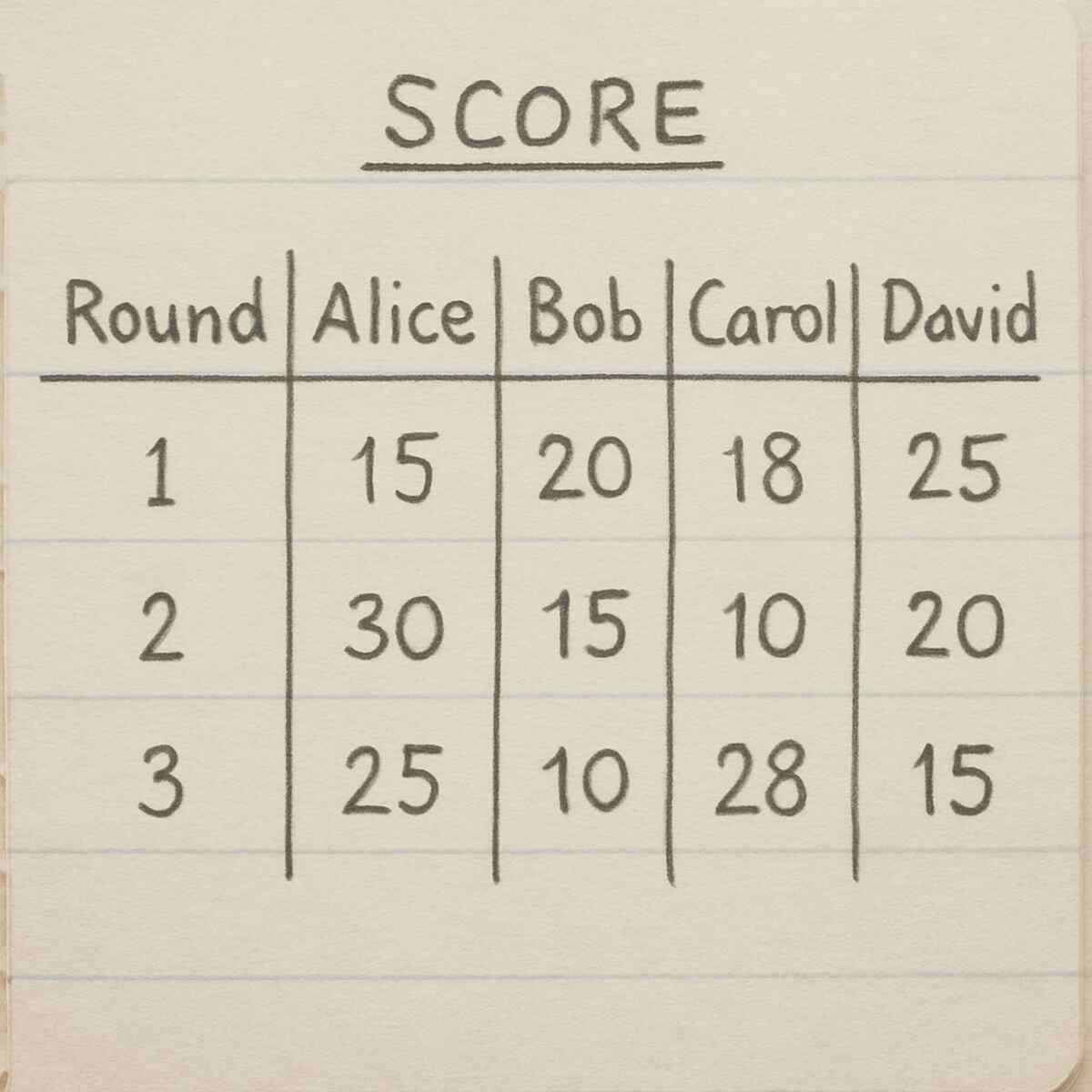
Keeping track of scores in Canadian Salad is simpler than you might think, and all you need is a pen and paper. Before you deal the first hand, create a simple grid. Write the name of each player across the top to make columns. Then, list the seven rounds down the left side to create rows. This structure makes following the game’s story easy, and is essential for good Salad game rules and scoring.
After each hand is played, the designated scorekeeper calculates the points for that round and writes each player’s score in the correct box. For example, if it was the “No Tricks” round and Tom unfortunately took two tricks, you’d write “20” in his column for that row. Your sheet will start to look something like the one pictured here.
(Image of a handwritten score sheet for a 4-player game, with the first three rounds—”No Tricks,” “No Hearts,” “No Queens”—filled in with sample scores.)
At the very end of the game, simply add up all the penalty points in each player’s column. Remember to subtract any points earned from the final “Tricks” round! The player with the lowest total score is the winner. To get you started right away, we’ve made it even easier:
- Download your free, printable score sheet for Salad game here!
With the mechanics of how to keep score now sorted, you can begin to think less about the rules and more about the gameplay.
3 Simple Strategies to Start Winning More Games
With the rules down, you can shift from simply playing to actively managing your hand. The key is shifting from just playing the cards you’re dealt to actively managing your hand. The most basic strategy involves your high cards (Aces, Kings). In penalty rounds like “No Tricks,” these are liabilities. A great opening move is to get rid of a high card by playing it on a trick someone else has already won with an even higher card, ensuring you don’t take it.
A powerful extension of this idea is to “void a suit.” This simply means getting rid of all your cards of a particular suit, like playing your last Diamond. Why is this so strong? Once you are void, you no longer have to follow suit. If another player leads a Diamond, you are now free to discard any card you want. This is the perfect opportunity to dump a high-penalty card, like the Queen of Spades or a pesky Heart, onto an opponent who is forced to take the trick.
Once you are “void” in a suit, you can start to “bleed” penalty cards from other players. For example, in the “No Hearts” round, if you know another player is also void in Clubs, you can lead a high Club. Since they can’t follow suit, they may be forced to play a Heart, taking points they desperately wanted to avoid. This turns your hand from a defensive one (just trying not to lose) into an offensive one where you dictate the flow of the game.
Mastering these tips is the first step in developing a real strategy for winning at the game Salad. While it’s more forgiving than card games similar to Contract Whist, you’ll find the tactical decisions in the Salad game vs Oh Hell offer a unique and rewarding challenge. You’re no longer just avoiding penalties; you’re strategically directing them. With this mindset, you’re ready to explore new ways to spice up the game.
Fun Variations and House Rules to Try Next
Once you’ve played a few games, you’ll discover one of Canadian Salad’s best features: it’s incredibly easy to customize. Part of the fun is tweaking the rules to fit your group’s personality, which is why there are so many popular Salad game variations and house rules out there. These aren’t strict changes, but rather fun suggestions to keep the game fresh every time you play.
Many families and groups add their own twists to the penalty rounds or scoring system. A few common ideas you can try include:
- No Men: In addition to “No Queens,” you can play a round where taking any Jack or King gives you 15 penalty points each.
- Double Trouble: To create a more dramatic finish, some groups agree to double all penalty points earned in the final “Salad” round.
- Rotating Trump: For a little more strategy, you can play the “Last Trick” round with a designated trump suit that overrules all others.
What if you have a smaller group? Adapting the game Salad for 3 players is simple: just remove one entire suit (like all the Clubs) from the deck before you deal. This keeps the hands balanced and the action moving quickly. These small changes ensure the game remains exciting without ever reaching the demanding complexity of card games similar to Contract Whist. Feel free to experiment and find the rules that make your game night the most fun.
You’re Ready to Play! Your First Game of Canadian Salad Awaits
Before you started, “Canadian Salad” was just a funny name for an unknown game. Now, you understand its rhythm—how the goal shifts with each round, turning your best cards into your worst enemies and back again. You’re ready to guide your friends and family through their first game, from dealing the cards to tallying the final, lowest score.
Remember, the goal of this Canadian Salad card game is simply to have the most fun by getting the fewest points. You’ll know you’ve learned how to play the card game Salad when you cleverly force a friend to take the dreaded Queen of Spades and you hear them groan—a sure sign of a game well played.
The best strategies for this trick-taking game aren’t found in guides; they’re discovered in the laughter and chaos of playing. The only thing left to do is grab a deck, gather some friends, and deal your first hand. Don’t worry about getting every rule perfect. Just enjoy the game.